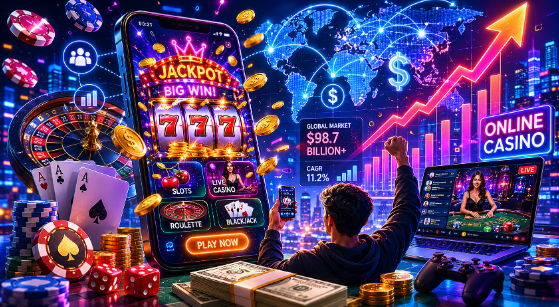

The world of digital entertainment has changed faster than anyone expected. A decade ago, most people still associated casinos with luxury buildings, poker tables, and neon lights in physical locations. Today, the industry exists almost entirely in the palm of a user’s hand. With smartphones becoming more powerful and internet access becoming cheaper, online casino entertainment has quietly evolved into one of the most profitable attention-based industries on the internet.
For millions of users worldwide, judi slot and online gambling platforms are now treated less like traditional betting systems and more like interactive entertainment products. The combination of fast gameplay, immersive visuals, and endless accessibility has transformed casino gaming into a digital habit that competes directly with social media, streaming apps, and mobile gaming platforms.
The Shift From Traditional Casinos to Digital Experiences
One of the biggest reasons behind the explosive growth of online casino entertainment is convenience. Traditional casinos require travel, time, and physical presence. Online platforms removed all of those barriers instantly.
Now, users can access thousands of games from their phones within seconds. Whether someone is commuting, relaxing at home, or scrolling late at night, casino platforms are always available. That constant accessibility changed the entire business model of gambling.
But convenience alone is not what made the industry worth billions.
Modern online casinos are designed with the same engagement strategies used by major tech companies. Smooth animations, instant loading systems, personalized recommendations, reward notifications, and mobile-first interfaces all play a role in keeping users active for longer sessions. The experience feels less like entering a gambling platform and more like opening a premium entertainment app.
This evolution has allowed online casinos to attract younger digital audiences who grew up with streaming platforms, online gaming, and fast-moving mobile content.
Why Slot Games Became the Center of the Industry
Among every category inside online gambling, slot games continue to dominate the market for one simple reason: they are built for instant engagement.
Unlike poker or sports betting, slot games do not require deep strategy or extensive knowledge. Users can start playing immediately without needing tutorials or complicated rules. That simplicity makes slots incredibly accessible to casual audiences.
Developers also understand the importance of visual stimulation. Modern slot games now look more like cinematic video games than classic casino machines. Themes inspired by mythology, futuristic cities, fantasy worlds, and adventure stories help create emotional engagement beyond simple gambling mechanics.
Sound design plays an equally important role. Every spin, bonus animation, and winning sequence is carefully engineered to create excitement. Combined with fast pacing and reward-driven systems, slot games become highly effective at maintaining user attention.
In many ways, the industry borrowed lessons directly from social media platforms and mobile gaming companies. The goal is no longer only about gambling — it is about maximizing engagement time.
The Role of Streaming Culture and Digital Communities
Another reason online casino entertainment exploded globally is the rise of streaming culture.
Live content completely changed how audiences interact with gambling platforms. Streamers now broadcast casino gameplay to thousands of viewers in real time, turning slot sessions and live table games into spectator entertainment.
For younger audiences especially, gambling content often feels similar to watching gaming streams or reaction videos. People watch for excitement, reactions, unpredictable moments, and community interaction. Chat features and live commentary create an environment where viewers feel connected even when they are not actively playing.
This trend helped normalize online gambling across digital culture.
Social media platforms also accelerated the industry’s growth. Viral clips of massive wins, flashy bonus rounds, and high-energy gameplay spread quickly across short-form video platforms. Casino brands learned how to market themselves using the same tactics employed by entertainment companies and influencers.
The result is an ecosystem where gambling content blends naturally into mainstream online media.
Technology Turned Gambling Into an Attention Economy
Behind the scenes, technology is driving almost every aspect of the industry’s success.
Artificial intelligence and behavioral analytics allow platforms to study how users interact with games in extraordinary detail. Companies can track session duration, preferred game styles, activity patterns, and user engagement behavior. Those insights help platforms optimize their interfaces to keep players returning consistently.
Mobile optimization has become especially important. Most users today access casino platforms through smartphones rather than desktop computers. Because of that, companies invest heavily in ultra-fast performance, responsive design, and frictionless payment systems.
Live casino technology has also transformed user expectations. Real-time dealers, HD streaming, and interactive tables recreate the atmosphere of physical casinos while preserving the convenience of digital access. For many users, this hybrid experience feels more immersive than traditional online gambling from years ago.
The industry no longer operates like old-school betting businesses. It now behaves like a modern tech sector focused on engagement, retention, and digital behavior analysis.
Where the Industry Goes From Here
The future of online casino entertainment will likely become even more immersive as technology evolves further.
Virtual reality environments, AI-powered personalization, blockchain payment systems, and social gaming integrations are already influencing the direction of the market. Companies are competing aggressively not only for money, but for user attention in an increasingly crowded digital world.
That is what makes the industry so powerful.
Online casino platforms are no longer competing only against each other. They are competing against TikTok, YouTube, Netflix, mobile gaming apps, and every other platform fighting for screen time. The companies that succeed are the ones capable of creating the strongest emotional engagement and the most addictive entertainment loops.
What started as a digital alternative to traditional gambling has evolved into something far larger — a global entertainment economy designed entirely around attention, interaction, and nonstop accessibility.