
The illicit practice of making substantial sums of money obtained through criminal activity—such as drug trafficking, tax evasion, or fraud—appear legitimate is known as money laundering. Criminals employ this intricate, multi-step process to hide the source of cash gained unlawfully and give them the appearance of legitimacy. The process of “cleaning” illicit funds so they can be utilized without arousing suspicion is the essence of money laundering.
What Is the Process of Money Laundering?
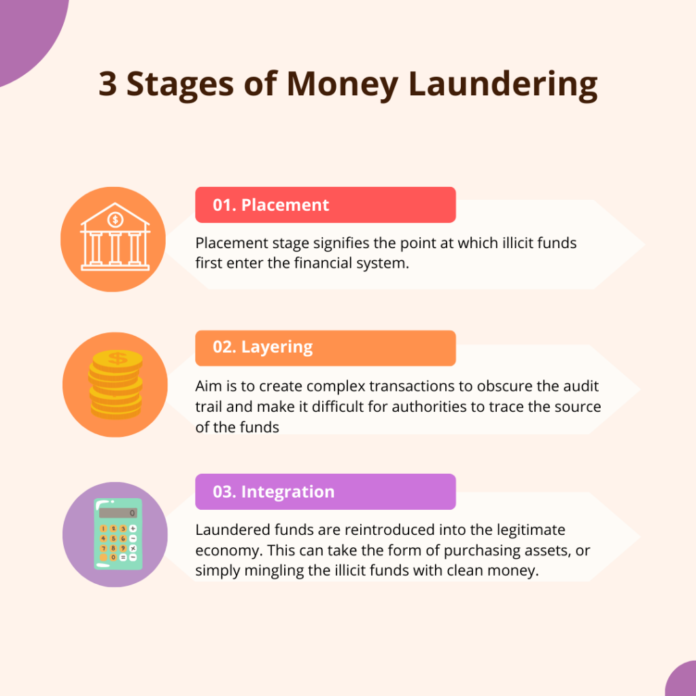
Three steps are often involved in money laundering: placement, layering, and integration. Each phase is broken down as follows:
Placement: Putting the money that was gained illegally into the financial system is the first step. This could entail spending the funds to buy products and services, buying assets like real estate, or putting them into a bank account. Distinguishing the illegal monies from their criminal sources is the aim of this stage.
Layering: To hide the trail of the illegal funds, the second level entails intricate financial activities. This can involve moving money from one account to another, switching currencies, or buying assets in one nation and selling them in another. Making it impossible for authorities to track down the money’s original source is the goal.
Integration: Reintegrating the newly “cleaned” money into the economy and giving the impression that it originates from reliable sources is the last step. This could entail investing, financing enterprises, or buying luxury products. The money can be utilized without causing suspicion once it has been properly integrated.
What Makes Money Laundering an Issue?
The global economy and financial systems are at serious risk from money laundering in a number of ways.
Undermines Financial Institutions: Financial institutions may be subject to legal repercussions, harm to their reputation, and loss of revenue as a result of money laundering. Strict procedures must be in place at banks and other financial institutions to identify and stop money laundering.
Encourages Crime: Money laundering helps to keep illicit operations like drug trafficking, terrorism, tax evasion, and human trafficking alive by enabling criminals to “clean” their proceeds. These illegal sectors flourish thanks to money laundering, endangering public safety and security.
Economic instability is caused by the flow of illegal money both inside and between countries, which skews market dynamics and prevents fair competition. It may result in financial fraud, unjust commercial practices, or even the demise of respectable companies.
How Do We Stop Money Laundering?
Governments and financial institutions have put in place a number of laws and regulations to detect and stop money laundering in order to combat the practice. These consist of:
Know Your Customer (KYC) Policies: In order to stop illicit activities, financial institutions must gather and confirm the identities of their clients. This stops thieves from creating accounts under bogus identities and aids in the detection of questionable activities.
Laws Against Money Laundering (AML): Businesses, particularly those in the financial industry, are required by national regulations to report suspicious activities and assist law enforcement. These regulations aid in spotting possible money laundering situations and stopping the flow of illegal payments.
Financial institutions must keep an eye on transactions for indications of money laundering, such as significant deposits or quick transfers between nations. Institutions are required to report suspicious activities to the appropriate authorities.
Well-known Money Laundering Cases
Numerous high-profile money laundering instances have garnered media attention over the years, including:
The Panama Papers: A large global money laundering network comprising offshore accounts and shell corporations used by criminals, politicians, and businesses to conceal illegal payments was made public in 2016 by the Panama Papers leak.
The Danske Bank Scandal: Denmark’s Danske Bank was implicated in one of the biggest money laundering scandals in history for allegedly permitting $200 billion in questionable transactions to pass through its Estonian branch.
The 1MDB Scandal: The misappropriation of billions of dollars from a government-owned investment fund was the subject of the 1MDB (1Malaysia Development Berhad) scandal in Malaysia. Through intricate financial operations involving international banks, the money was laundered.
In conclusion
Money laundering is a serious worldwide problem that jeopardizes economic stability, encourages criminal activity, and jeopardizes the integrity of financial institutions. From bringing illicit monies into the system to finally “cleaning” them for lawful use, it is a multi-stage, intricate crime. Around the world, governments, law enforcement, and financial institutions put in a lot of effort to prevent money laundering through rules, reporting obligations, and careful observation of questionable activities. To maintain a just and stable global economy, the fight against money laundering is crucial.